
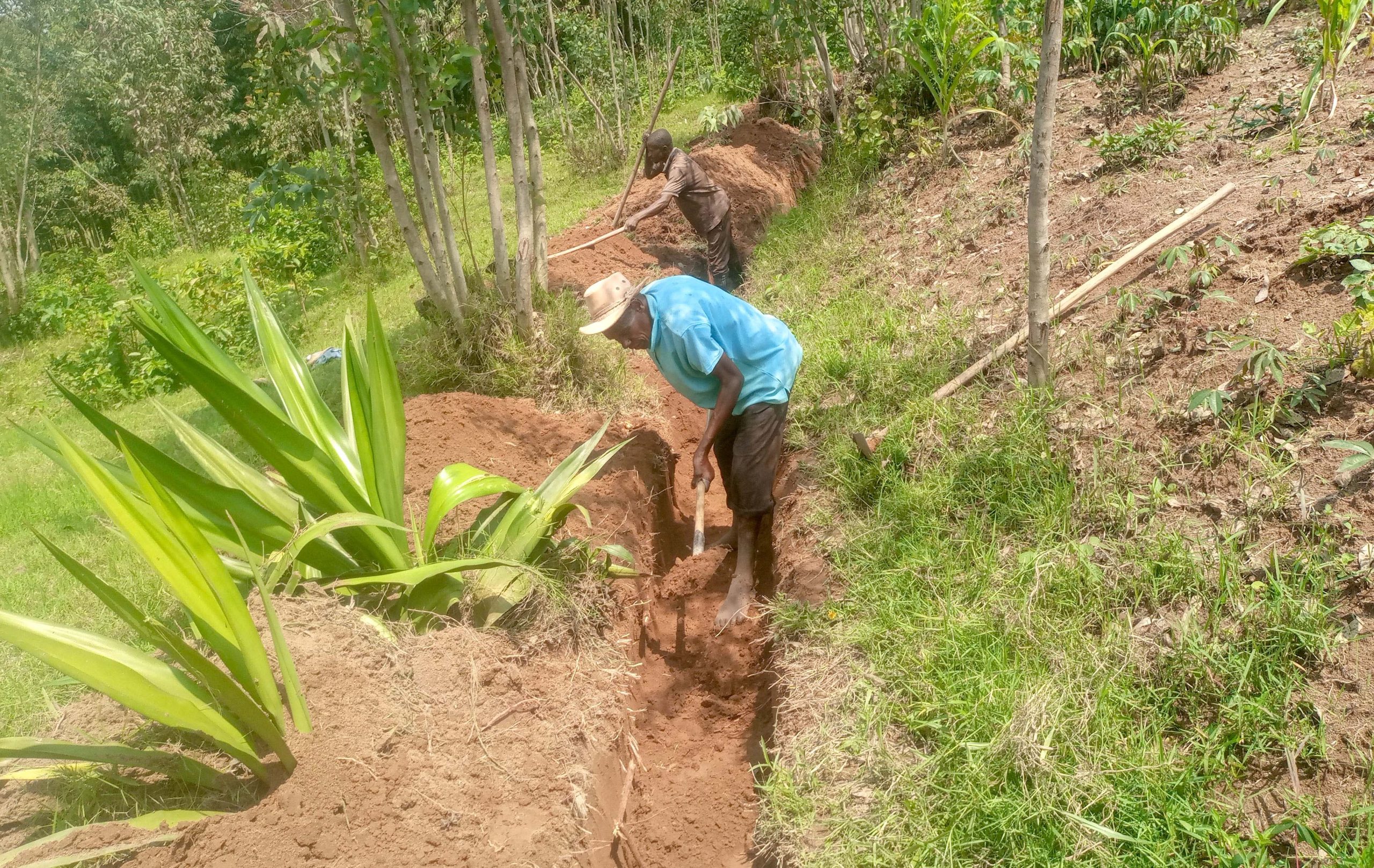
Action pour la Protection de l’Environnement et la Promotion des Filières Agricoles (APEFA), with support from the Rwanda Green Fund (RGF), is making steady progress in the implementation of the Building Climate Resilient Communities of the Akaziga Watershed Project in Busasamana Sector, Nyanza District.
The project, running from June 2025 to June 2027, targets 11,213 vulnerable smallholder farming households across 16 hillside villages within the Akaziga watershed. The initiative aims to strengthen climate resilience, restore degraded ecosystems, and enhance sustainable livelihoods in one of the areas increasingly affected by erratic rainfall, droughts, landslides, and flooding.
Strengthening Watershed Protection and Land Management
During the period of June–December 2025, the project focused primarily on start-up activities and foundational interventions critical to long-term success.
A major milestone achieved was the completion of the detailed design and engineering studies for the rehabilitation and development of Nyamagana Marshland. This technical groundwork provides a clear roadmap for the marshland restoration phase.
In parallel, significant progress was recorded in soil conservation measures:
- 204 hectares of progressive terraces constructed (54%)
- 190 hectares of ditches stabilized with grasses
Additionally, 204 hectares of trenches were created to enhance watershed protection and reduce soil erosion. A tree nursery has also been successfully established and is currently producing agroforestry seedlings that are being planted to stabilize terraces and rehabilitating degraded areas.
Creating jobs and promoting gender inclusion
Beyond environmental restoration, the project is generating meaningful socio-economic impact. So far, 169 residents have been employed in trench excavation and nursery operations, including: 99 women (58%) and 70 men (42%).
This inclusive approach reflects APEFA’s commitment to reducing gender inequalities by ensuring that at least 50% of beneficiaries are women. By promoting women’s participation in environmental management and income-generating activities, the project contributes to both economic empowerment and community ownership.
Laying the Foundation for Long-Term Impact
With an overall physical progress of 35%, the project is progressing steadily and is expected to continue smooth implementation toward achieving its objectives within the planned timeframe.
By 2027, the project aims to:
- Develop and protect 374 hectares of progressive terraces
- Restore 25 hectares of riparian zones
- Support 45 farmers with agricultural inputs and insurance
- Promote agroforestry, irrigation efficiency, and climate-smart agriculture
Through a participatory and integrated approach, APEFA and its partners are building the adaptive capacity of vulnerable communities in the Akaziga watershed ensuring that environmental restoration goes hand in hand with improved livelihoods and sustainable development.
As the project transitions from start-up to full-scale implementation, stronger momentum is expected in the coming months, reinforcing APEFA’s mission.
MORE PHOTOS


