
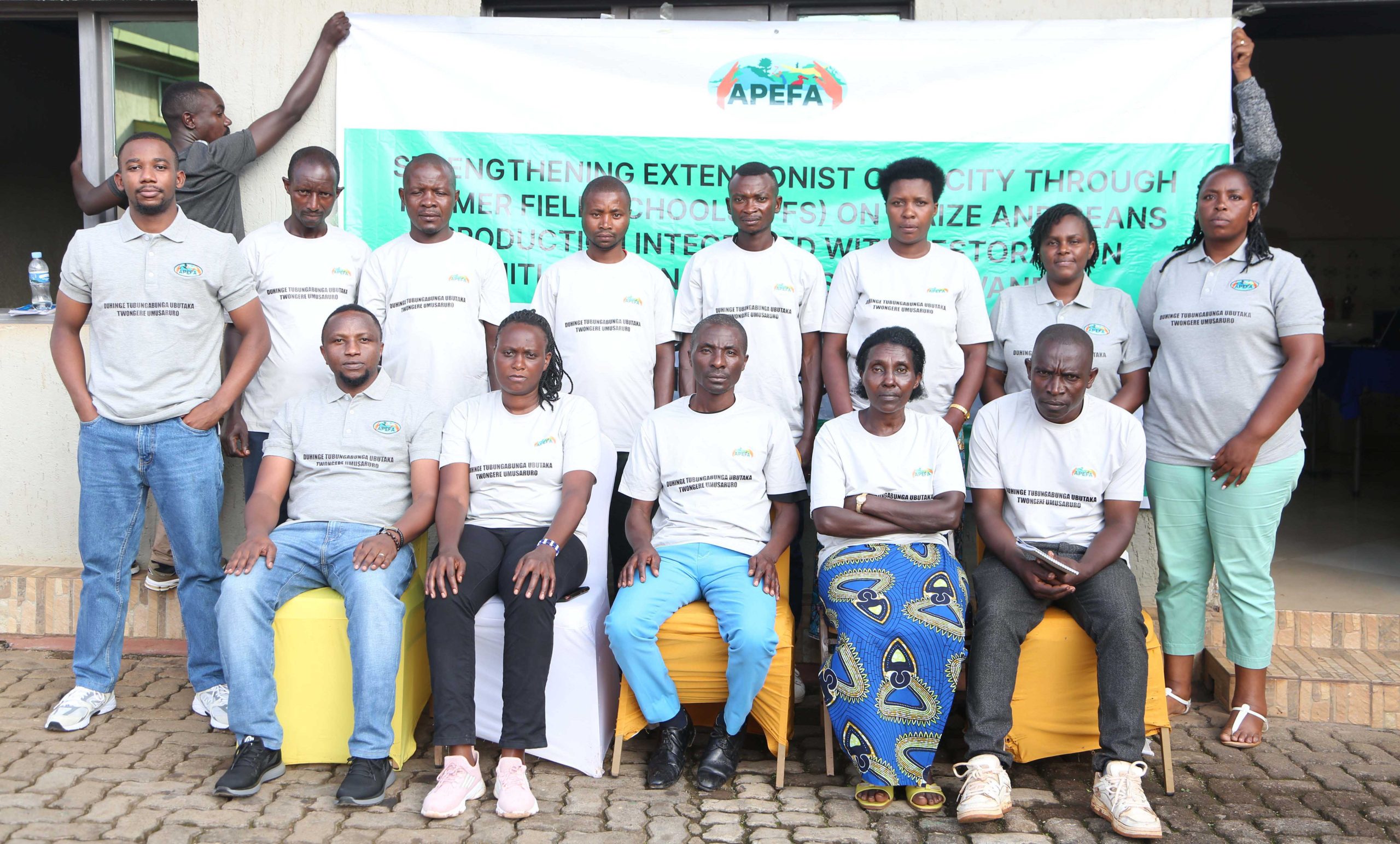
Under the project “Strengthening Extensionists’ Capacity through Farmer Field Schools (FFS) on Maize and Vegetable Production, Integrated with Restoration Initiatives in Rusizi District,” Action pour la Protection de l’Environnement et la Promotion des Filières Agricoles (APEFA), in collaboration with the World Resources Institute (WRI), successfully conducted a three-day Training of Trainers (ToT) on agroecological practices. The training took place from 16 to 18 February 2026 at Progress Hotel in Rusizi District.

The training aimed to strengthen the technical knowledge and practical skills of the participants, enabling them to support the implementation of agro ecological practices that complement ongoing land restoration efforts in the district.
A total of 10 trainers(4 women and 6 men) participated in the ToT. Each trainer will go on to train 10 farmers, reaching at least 100 farmers through the Farmer Field School (FFS) model. Demonstration plots will be established within the 2 intervention Cells of Gashonga Sector to provide hands-on learning, allowing farmers involved in restoration activities to replicate agroecological practices in their own farms.

The rollout of these coaching sessions is scheduled from March to June 2026, aligning with the agricultural season B.
Participants gained knowledge on key agroecology principles, soil health management, agrobiodiversity and seed systems, integrated pest management, and market linkages. The training also focused on sustainable practices for priority crops, particularly beans, in line with district priorities.

The final day featured a practical session at a farmer’s site in Gashonga Sector, where participants applied techniques learned in the training room. Activities included:
- Compost preparation using locally available organic materials
- Soil erosion control
- Production and application of natural pesticides
This hands-on approach strengthened participants’ confidence and practical understanding, fostering teamwork and readiness to promote these practices in their communities.

By the end of the training, participants developed a comprehensive action plan outlining key activities, roles, responsibilities, timelines, and monitoring mechanisms. This roadmap ensures effective coordination, accountability, and timely implementation of project activities.
The training successfully achieved its objectives, equipping trainers with the skills needed to support farmer groups under the FFS model. By promoting agroecological practices, the initiative is expected to enhance soil health, climate resilience, and sustainable agricultural productivity, contributing to the broader goals of the Food production in Restoration Project and creating lasting impact for communities across Rusizi District starting from Gashonga Sector- Muti and Kamurehe Cells.
MORE PHOTOS


